
Showing posts with label Napoleon. Show all posts

Tuesday, July 19, 2011

The Uncommon Honeybee


Years ago, honeybees were common in gardens. Now, they have become rather rare in many areas. I had not seen a real honeybee in the garden for a number of years until today. Early this morning, I went outside before the hideous effects of the current heat wave became too intense, to enjoy a cup of coffee amidst the flowers. It was then that I spied a honeybee flitting from flower to flower. There was only one bee but it made a valiant attempt to pollinate as many flowers as possible. I was struck by its beauty, glossy like silk velvet.

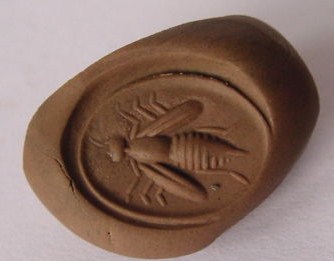
The bee is an ancient symbol of industry. It was popular in ancient Rome as well as medieval and Renaissance Europe. Napoleon took it as his symbol as well. I had a chance to purchase a Roman seal ring with a bee on it a couple of years ago but I resisted the temptation. As with any 'missed' unique item, I regret my temporary strength of will now. I doubt I shall have an opportunity like that again.

As a child, I remember that our garden buzzed with honeybees. It is sad that the bees have departed from so-called 'civilised' environs, but I am delighted to have seen one this morning.

The Etruscans would have believed the sighting to be an omen from the gods. If so, what does it portend for me?

Monday, May 5, 2008

The 5th of May: Tribute to the Emperor


Today is the 5th of May. 'Lest we forget', I am posting a quick photograph of a statue of the Emperor based on the famous painting of 'Bonaparte Crossing the Alps'. Violets of Parma are set beneath it. Violets, of course, were the traditional tribute paid to the Emperor by those who loved and believed in him... and one still finds them at his Tomb at Les Invalides. In fact, I laid them there myself whenever I had the opportunity to visit.

For those who may be unaware of the significance of the date, it is, of course, the anniversary of the day on which the Emperor died on the island of St. Helena.

I have not been to Paris for many years, but I did chance upon a house where Napoleon stayed for 7 fateful days in Valletta in Malta. In fact, a plaque on the wall of the building commemorates the most distinguished visitor of all time.

I do not like random individuals in my photographs so I have been obliged to crop the photographs ruthlessly in order to circumvent the view of people reluctant to move out of the way... Nonetheless, one should be able to obtain a fairly decent idea of the Parisi Palace in which the renowned young hero spent a week...

In fact, it is a very fine building in its own right. The long enclosed window balcony, in particular, is characteristic of Maltese urban architecture. Malta in general impressed me enormously. The language is extraordinary, representing a rather unique marriage between two of my own favourite languages, Arabic and Latin. Even were it not for the incredible megalithic sites on the islands, one would have to fall in love with Malta, despite the corruption of the Knights Templar who are responsible for much of its baroque beauty.

It is not Malta, however, but Napoleon who should be remembered on this day. Alas, I have no Napoleon pastries to serve at tea in memory of the Emperor, nor is it likely that I shall be able to find the ingredients for Chicken Marengo today. Nonetheless, I salute him in my heart and soul and I wear the tribute that never leaves my neck: a 40 franc gold Napoleon. It is an unusual coin and personally significant to me in that it was struck for him in his position as 'Re d'Italia' as well as Emperor of the French. There have been few to equal him in the history of this world, for better or worse.

Saturday, May 5, 2007

Tomb of the Emperor at Les Invalides


Here is a photograph of the beautiful tomb of Napoleon at Les Invalides. Actually, our own annual ritual of commemoration of the death of the Emperor was not a grim event, but mainly involved food. We had Napoleon pastries at teatime, and I always was in charge of cooking Chicken Marengo for dinner afterwards. A small plaque decorated with the unfinished portrait by David (my absolute favourite) held the place of honour at the table.

The recipe for Chicken Marengo, for any one who wishes to commemorate the death of the Emperor in like manner:

Traditional Chicken Marengo

Ingredients:
2 chickens, cut in pieces, either in quarters or in smaller portions
2 cups plum tomatoes, skinned and cut

1 onion, sliced thin
2 cloves garlic, crushed
16 small white onions (pearl onions)
1/2 pound fresh sliced mushrooms
1 cup pitted black olives

Olive oil
1/4 cup butter

1/2 teaspoon thyme
1 bay leaf
3 tablespoons chopped fresh parsley
sprigs of fresh parsley

1 cup chicken stock
1/2 cup dry white wine
1 jigger brandy
juice of 1 lemon

Preparation:

First saute the sliced onion in olive oil until light golden in colour, then remove onion and set it aside. Add chicken to the oil and brown it on all sides.

Now add the plum tomatoes, crushed garlic cloves, thyme, bay leaf, sprigs of parsley, chicken stock and dry white wine. (For those who prefer less garlic in their dishes, use whole garlic gloves instead of crushed. If you really do not like much garlic at all, fry the whole garlic gloves with the onion, then remove them and set them aside as well.) Cover the pot and simmer for about an hour, until the meat is quite tender, even falling from the bones. When the meat is done, remove it from the pot and set it on a platter.

Reduce the sauce for about five minutes. If you want a more delicate dish, strain the sauce before you reduce it. Season it to taste with salt and pepper.

In a separate pan, saute the small white onions (pearl onions) with the sliced mushrooms in butter and lemon juice.

Now use a deep earthenware dish or other casserole dish to arrange the following:
chicken, mushrooms, small white onions and pitted black olives. Sprinkle brandy over it, then add the reduced sauce.

Heat in an oven at 350 degrees, then decorate with chopped parsley.

Serve with boiled rice.

Vive l'Empereur!

N.B. This dish originally was created for Napoleon by his cook on the battlefield of Marengo, the site of one of his earliest victories.

The 5th of May


Portrait of Napoleon by David

As I have determined to write about Festivals and rituals both of celebration and commemoration, I cannot ignore the 5th of May.

From earliest childhood, the 5th of May has been an important day of the year for me. Others may know it primarily as the 'Cinco de Maya', a festival that celebrates Mexican independence. I always wore a black armband on this day, making me extremely unpopular in some quarters to those who mistakenly assumed that I was opposed to Mexican independence for some reason. I wish that Cinco de Maya were NOT the 5th of May, but inherent in the very name of the festival is the day itself. (Ironically, it is a Mexican victory over the French army of Napoleon III that Cinco de Maya celebrates.)

The 5th of May is the day on which Napoleon died. Even now, when I have become painfully aware of the shortcomings of the man and the political mistakes he made, I continue to admire the hero. Napoleon Bonaparte was my first love. I dreamed of him, and I made a pilgrimage to Les Invalides each time I visited Paris. When possible, I laid a tiny offering of violets at his tomb.

When I think of Napoleon, I do not think of the Emperor in all his glory. I think of the painfully shy young man, slightly alienated from his peers, an outsider with a Corsican accent, who yet believed in his destiny and followed his star with unshakable determination. To me, that was his greatest accomplishment: his belief in himself and in his duty to change the world.

The fact that he was able to endear himself to the common soldier, to share their privations and their hardships and to inspire the sort of loyalty that allowed him to return from Elba and create a new army from nothing... that is the Napoleon I admire.

To me, his greatest flaws were his execrable taste in women and his misguided campaigns in the Arab world and Russia. The Code Napoleon is an incredible accomplishment, and he did not delegate his tasks to others. He was the sort of man who had to be involved personally in every detail.

If I had been born in that period and had the extraordinary good fortune to meet him, I suspect that I might not have fancied him as much as I did as a teenage girl from the distance of two centuries. Even so, I would like to think that I would have recognised his greatness and not viewed him with the same sort of profound disgust with which I judge most politicians. To Napoleon's credit, he was NOT a politician but a leader and a general. There is a difference. A half-wit like George Bush can strut about in military accoutrements pretending to be some one, but at the end of the day, his claim to fame will rest solely upon his crimes against humanity, and those were committed by other men and women acting in his name.

My continuing fascination with Napoleon really cannot be justified intellectually at this point in my life. It is founded now upon nostalgia and memories of my own adolescence. Nonetheless, I must salute my Emperor on the 5th of May as I have done since I was a child.